Archive for Lean Six Sigma

Tracey Richardson’s How to implement “Lean Thinking” in a Business is  my third and final blog review for the John Hunter’s Curious Cat Management Improvement Blog Carnival.   Tracey is a trainer, consultant and principal of Teaching Lean Inc. She has 22 years of Lean experience and worked at Toyota Motor Manufacturing KY as a team member, team leader and group leader in the Plastics Department from 1988-1998. She has over 460 hours training in Toyota Methodologies and Philosophy and currently is a trainer for Toyota, their affiliates in North America, and other companies upon request. Tracey experience in Toyota methodologies including: Lean Problem Solving, Quality Circles, Lean Manufacturing tools, Standardized Work, Job Instruction Training, Toyota Production System, Toyota Way Values, Culture Development, Visualization (Workplace Management Systems), Continuous Improvement (Kaizen), Meeting Facilitation/Teamwork, and Manufacturing Simulations.

Tracey also was the 2010 recipient of the Business901 Podcast of the Year! The podcast discussed A3 problem Solving.

Tracey likes to discuss the culture before jumping into problem solving but she takes a look at culture from a different perspective than others. It just about comes across as an attitude (in a very polite way) and there is type of swagger about the whole thing. Why not? When you become #1 in the world such as Toyota did and you are #1 methodology in the world which Lean probably is, why not have that swagger to your discussion? It is not pompous, it is an attitude that what you are doing works! She doesn’t write enough in my opinion because of her commitments as a trainer but her blog is one you should follow, you do not want to miss a word she says. You can also find her answering questions on the Lean Enterprise’s A3 Dojo Website.

What does the word “Lean” mean to you or your Company?

As I travel around the U.S. working with various companies that make a variety of different products, I realize a common denominator throughout them. How do they define the word “lean”, as well as the word “culture”? What I have realized is very interesting!

When I first started consulting I felt it was all about the “tools”, and that’s what companies seem to want, so of course, that’s what they got. As I have matured as an instructor/consultant I, like many, I have led and learned at the same time. In my experience at Toyota, especially back when we were led by the Japanese and their questioning approach; we all as new leaders were being led but at the same time leading others, so it was bringing about the “respect for people” and developing the workforce as a team. I can’t ever recall in my time at Toyota (Toyota Motor Manufacturing KY – TMMK 1988-1998), that we ever labeled what we were doing in a specific word like “Lean”, nor did we really think about our daily actions as a “culture”. It was just in the atmosphere. It wasn’t until I left Toyota to teach others, that those words started to surface. Somehow we felt the need to give it a name, and as I’ve experience the last 13 years as a consultant, I feel that can have somewhat of a hindering effect…..

Pathway to creating a “Lean Culture”

As I travel around to various clients they are always asking me, “How do you implement or create a culture like Toyota has”? I tell them that’s a very loaded question :). There are so many aspects of creating that culture it’s hard to give a short answer or even “wave a magic wand” to say… “Here is what you should do!!”. I wish I was that good . How I see it, you really need to differentiate the People side of Lean versus the Tool side. The People side will always be the most difficult aspect of the discipline needed to create this thing called Culture. The tools are just what they are, mostly countermeasures to change some discrepancy in our process. For the tools to be successful, People must understand their involvement or the purpose behind the tools. As I have stated in previous blog posts you must explain from the company perspective the WHAT, HOW and the WHY of any change or expectation within a persons work….

Tracey’s website: http://teachingleaninc.com and email: tracey@teachingleaninc.com

Related Information:
Blog Carnival Annual Roundup 2011: Graham Hill at CustomerThink
Blog Carnival Annual Roundup: 2011: The 99 Percent Solution
LabWorks Opens in the Lean Marketing Lab
The importance of PDCA in Marketing

Share this:
Share this page via Email Share this page via Stumble Upon Share this page via Digg this Share this page via Facebook Share this page via Twitter
Categories : A3, Lean Six Sigma, PDCA
Comments (0)

Graham works in innovation, service design, value co-creation and private equity with DesignThinkers, Optima Partners, Loyalty Factory, and Nyras Capital. Graham was formally the head of CRM at Toyota Financial Services and can be found at the Customer Insider Blog on the Customer Think website. I am honored this year to be part of John Hunter’s Curious Cat Management Improvement Blog Carnival and equally honored to introduce Graham to this audience. Graham Hill

For several years now, I have been developing concepts and practicing Lean Marketing in conjunction with Six Sigma, and the Theory of Constraints. Lean was always the guiding light but it was not till I started to get involved in Service-Dominant Logic, Service Design and Design Thinking that my thoughts crystallized. In fact, it strengthened and reinforced my Lean Thinking. Lean has developed as the architecture in software over disciplines such as Agile, Scrum and Kanban. Lean has similarly developed as my architecture for sales and marketing. Graham Hill did not start me down this path but he has certainly reinforced my thinking with his comments and articles he presents. I remember few doors that have been open such a vast amount of knowledge and learned experiences than Graham did when he used 3 tweets to say:

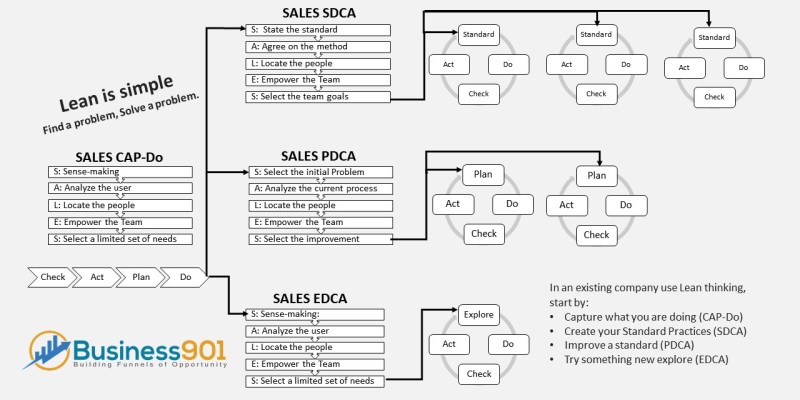
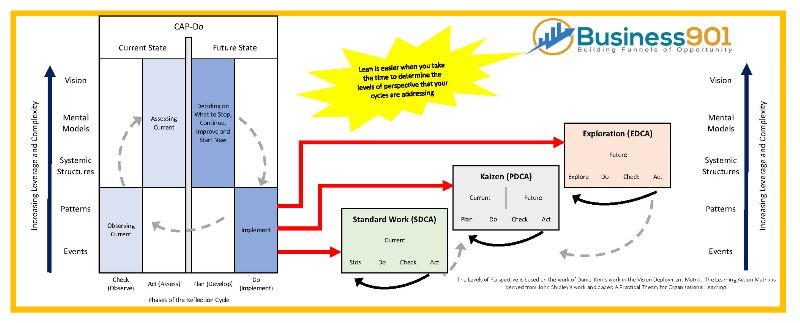
Marketing in highly competitive markets is about exploring new propositions on the innovation fitness landscape. The environment determines where to start and complex marketing environments need EDCA. Complicated ones often start with PDCA ½.” EDCA = Explore, PDCA = Plan, SDCA = Standardize. Marketing Operations is all about moving along the EDCA>PDCA>SDCA pathway.

Another comment of Graham’s that reinforced my journey into Design Thinking and Service Design:

I was taught and used Toyota’s approach to lean, to improve all aspects of Toyota’s and its dealers’ customer-facing business. Toyota doesn’t see lean as a collection of tools (unlike many so-called lean experts), but rather as an organizational philosophy to engage the whole organization in creating more value together with customers. Toyota’s approach to lean is much closer to design thinking than you may think.

You can read the entire explanation on this blog post, Asking the right questions about Lean?

The real value that you derive from following Graham is his cutting edge thoughts and practices that he exhibits in his Customer Insider blog, such as:

Seven Simple Steps Towards Better Collaboration: In an earlier post on CustomerThink I described Ten Principles that Drive Effective Collaboration. And why just implementing collaboration technology would not improve collaboration. Worse, how it would make you into an ‘Expensive Old Organization’; with all the costs of the new technology, but none of the desired benefits. If simply implementing new technology isn’t the way to increase collaboration, what is? Fortunately getting started with collaboration is much easier than you might think. In fact, you are probably doing some of it already.

What’s Your Platform for Value Co-Creation?: A couple of years back I wrote a speculative blog post at CustomerThink entitled How Customer Co-Creation is the Future of Business. In many ways my prediction was right, Customer Co-Creation IS the future of business, but not exactly in the way I had imagined.

Customer Relationship Management (CRM) has been with us for over 20 years. It is built around using customer analytics to improve marketing, sales and service touchpoints. And it works very well. Or at least it does for companies. But it doesn’t offer much of any value to their customers. And as a result, its effectiveness has started to fall.

Customer Experience Management (CExM) was created about 10 years ago as an antidote to the blatant one-sidedness of CRM. It still uses the same customer analytics, but it applies the insights generated to improve all the…

Social CRM: What’s Right, What’s Wrong, What’s Next? Inside Scoop with Graham Hill: CustomerThink Founder/CEO Bob Thompson interviewed Graham Hill in a discussion about Social CRM.

P.S. In the world of Social Media, I can think of few people that have a more engaged following especially from an individual that uses it to serve his purpose (not meant in a selfish manner) in lieu of having a social media presence. You can tweet him @grahamhill.

Related Information:
Carnival page on the Curious Cat Management Improvement Blog
Blog Carnival Annual Roundup: 2011: The 99 Percent Solution
The Common Thread of Design Thinking, Service Design and Lean Marketing
Value can no longer be defined as What a Customer will pay for!

Share this:
Share this page via Email Share this page via Stumble Upon Share this page via Digg this Share this page via Facebook Share this page via Twitter
Comments (0)
Dec
15

Six Sources of Influence in Change

Posted by: | Comments (0)

From my blog post, The Difficulty of Mastery = The Difficulty of Lean, I started discussing the book, Change Anything: The New Science of Personal Success . I found the work paralleling Lean in many of its approaches and put Lean practices in parenthesis. Their strategy is based on four simple steps:

  1. Identify Crucial Moments (Identify Value)
  2. Create Vital Behaviors (Map Value Stream)
  3. Engage All Six Sources of Influence (Create Flow – Enable Pull)
  4. Turn Bad Days into Good Data (Seek Perfection – PDCA)

I stopped short of discussing the six sources of influence and have included them here:

  1. Personal Motivation
  2. Personal Ability
  3. Social Motivation
  4. Social Ability
  5. Structural Motivation
  6. Structural Ability

I am going to use a different perspective on these influences looking at it from a perspective of an organization trying to change and using Lean and my own thoughts to orchestrate the change.

Organizational Motivation will never persist without the change being tied to the marketplace. Dan Jones recently wrote in the blogpost, How can Lean Survive that “The best chance for lean to survive a change in top management is if it is seen to be delivering significant results, not just point improvements in key processes but bottom-line results for the organization as a whole, which would be reversed if support for lean disappeared. I disagree with the statements that you just have to accept that it is going to work and not expect results. Results are the motivating factors.

Organizational Ability requires learning new skills if you are going to change. If change is difficult we will take the path of least resistance. Mastering a new set of tools is never easy and that is why Lean is so powerful. Lean is based on standards, knowing how the process should work because if it’s clear, then when we see a variation from the process we can react immediately. This allows us to choose one problem from the other and just solve them one by one. This is incredibly powerful because with lean systems we rely on increasing our competency, increasing our training without having to take people off line, without having to get to classrooms, but by building it into the way we work.

Social Motivation and Social Ability go hand in hand. Employees, Suppliers, and even Customers would rather you not change. They want to deal with the known. Even voters will vote for someone that they know and disagree with over the unknown. You have to re-define the norm for example through Value Stream Mapping or an A3. You have to get those around you on board with the new ideal or without you will fall victim to those old tired out ways that have become ineffective. Surround yourself with willing partners that will push you to this new ideal. This is sometimes where a consultant can play a role.

Structural Motivation can be difficult in organizations since external goals are difficult to recognize. We can see internal improvements sometimes immediately. But these internal improvements may not result in the needle being moved in the marketplace. An effective motivator may be the fear of loss. Can you tie lost market opportunities to your change efforts? Can you demonstrate even the smallest of wins? If you can, it will significantly increase the odds of success.

Structural Ability small changes in your environment have a surprising effect on your choices. This is where Lean plays such a huge role in change. Lean is not rigorous. It uses visualization and it’s a readymade tool set that reduces the resistance to change. What Lean does require though is rigorous use to be successful.

Lean is a change tool but it is not a cure all. Dr. Balle said in an interview with me, “Lean is not a revolution; it is find one problem and solve one problem.” I wish you the best on your journey of change!

Related Information:
Inspiring Innovation thru Standard Work
Value can no longer be defined as What a Customer will pay for!
The importance of PDCA in Marketing
Even Seinfeld used Standard Work

Share this:
Share this page via Email Share this page via Stumble Upon Share this page via Digg this Share this page via Facebook Share this page via Twitter
Categories : Lean Six Sigma, PDCA
Comments (0)

I have seen numerous times where Dr. Jeffrey Liker prominent author of the Toyota Way Series has claimed that less than 1% of companies are successful with Lean. I am not sure what criteria he bases this number on exactly but if he is even close why are we doing it? If you have studied Lean and any of Dr. Deming’s material, it would say  it’s the process not the people. Therefore, would we not have to say this failure is the process not the organization? So, if Lean has this high of failure rate why are we doing it?

When I ask this question of many “Lean” people they have a tendency to answer the question based on why companies are not successful. I never intended to ask this question to beat up on the companies trying to implement Lean. They have a tough enough job. Many will point to leadership saying that they are at fault. Truth be known, they are responsible. That is why we call them leaders. But if I am a leader and something is only having a 1% success rate, why am I going to go down that path? Why would I contemplate Lean?

The fact is that Lean, Six Sigma, TQM and many methodologies work. The fact is most weight-loss programs work. The problem is most people; most organizations don’t master them to make them successful. As Dan Pink said, “Mastery is hard.” Hence, less than 1% of companies are successful with Lean or even something as simple as a weight loss program. You can find plenty of advice; you can read books, go to seminars and enroll in programs. I am not against professional advice mind you; they have experience and knowledge that you may not have in your organization. But this is where your plan may break down. Look at all your diet plans for example, why do they stop working? It’s you, not the plan.

What does work is the same thing for both people and organizations. It is the scientific process of trial and error. You don’t get it right at first, you have to break habits, personal habits as an individual and company cultures as an organization. Successful companies do it a little bit at a time. In Lean, we call this scientific method PDCA. We plan, do it, check the results and adjust. It is a purposeful experimentation.

To me, this is the excitement of Lean, is this empowering aspect that is not easy. You teach people, rather than solve people’s problems for them. And in doing so, they learn how to make better decisions which leads to better performance.

Dr. Michael Balle stated in an interview with me, “Lean gives you an ideal; it’s a commitment to an ideal.” More importantly, you must understand your own organization, the culture that exist and the culture that your customers expect and are willing to derive value from. You have to make the process your own. You have to rid yourself of Lean or other business processes. Dr. Liker’s statement is exactly correct because successful companies that started down a Lean path are not Lean anymore, only the unsuccessful ones are. If you are successful at implementing Lean, it is simply not Lean. It’s yours.

Related Information:
Developing a winning Culture the Zappos way!
Servant Leadership in the Toyota Culture
What will your workplace be like in 2020?
The importance of PDCA in Marketing

Share this:
Share this page via Email Share this page via Stumble Upon Share this page via Digg this Share this page via Facebook Share this page via Twitter
Categories : Lean Six Sigma
Comments (6)