Archive for Lean Startup
Industrial iPad Case – Moving Digital to Shop Floor
Posted by: | CommentsThe Trego is a wearable case for the iPad allowing for true portability of your iPad whether you are on the loading dock, stacking boxes or at a trade show. It extends the functionality of the iPad no matter if you are sitting, standing or taking payment. You can even flip the screen for a signature.
This video demonstrates a few of the Trego Bag’s features that may be used by CIA operatives (just joking) in the near future.
Disclaimer: There is a business relationship that exists with the distribution of this product.
Lean Scale Up Webinar
Posted by: | CommentsThis is not about finding product market fit or minimum viable product (MVP). It is not about starting a business. If you are looking for rapid growth with the purpose of being acquired, this may not be the fast-track investor-rich style of growth that may be needed. The organizations that will benefit most are small companies that want to establish a method for achieving and sustaining organic growth. To benefit the most, your organization should have a commercially viable product or service (CVP/CVS).
I apologize for some of the editing. I was not the host of this video and had to splice a few parts in and also remove the Q and A section of the webinar.
For more information and a free downloadable eBook Visit, Lean Scale Up in the Business901 Training Section.
Is The Lean Startup a Disrupter or Savior for the Lean Enterprise
Posted by: | CommentsI see statements from the Lean StartupTM folks that The Lean Startup is changing everything. I think that is rather silly because it is not The Lean Startup that is causing the change. The Lean Startup is just adapting to the way the world is changing.
Lean works well for groups that do not rely on an external environment to function, ones that can be self-reflective and internally focused on improvement. However, that business model is getting smaller and smaller. The rapid expansion of knowledge is decreasing the advantages of past proprietary offerings in product/service and in operations. What is left is a complex web of internal and external activities that I use Service Dominant Logic to describe.
If we have learned anything from The Lean Startup, it should be Steve Blank’s mantra of “Get out of the Building” has surpassed the outdated Voice of Customer Model. The instrument of Gemba Walks should no longer be only thought of as an internal practice on the shop floor, rather an external practice at the customer point of use of your product/service offering, not at the point of transaction. Customers are now being redefined as users. It is in this concept that we must build our structure around, reaching out past the user to find new synergies, new connections at the fringes which will result in new ways to create value.
Hoshin Kanri is the traditional Lean practice for building strategy and vision. It is a Lean Leadership tool for communication. What fails is the faulty assumption that we can still rely on data gathering and Voice of Customer techniques. It is not the concept of Voice of Customer rather the tools we use to gather this information. Surveys and Focus Groups need to be replaced with senior leadership actively participating with client-facing techniques that resemble a good old-fashioned discussion. Discussions of this sort lead to discovery. Ask any Lean Startup that has tried a Problem Interview or a Solution Interview. For a description of a Lean Startup interview process, I recommend Ash Maurya’s book, Running Lean
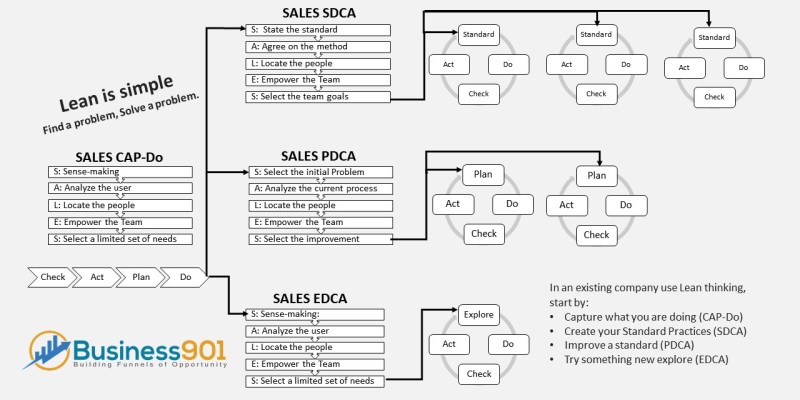
Lean needs to adapt its thinking and seek new ways to engage the users in their learning cycles. The methods of SDCA-PDCA-EDCA are well suited for this new environment. The practice of Hoshin Kanri lends itself for adaption of this new thinking throughout the organization. However, it will take a change in thinking of many established Lean Enterprises and Organizations if Lean is to continue to flourish.
Other process methodologies of the 90s are floundering; Lean is flourishing because it has been the most adaptable. It has spread to many disciplines through an internal focus on improvement. However, it may be ripe for disruption as the external forces of the marketplace take hold. Will the Lean Startup be an instrument of disruption or a savior for its Lean counterpart?
P.S. This blog post is an extension of my recent posts, Is Lean Playing to Win? Part 1 of 2 and Is Lean Playing to Win? Part 2 of 2. The posts are my reactions to this LinkedIn thread, What do we have to do to have Lean survive a leadership change?,
Lean Scale Up Infographic
Posted by: | CommentsSome believe The Death of Innovation, the End of Growth is here. Others believe it is a race against technology, The Key to Growth? Race with the Machines. I believe growth is not easy. However, why not simplify the process and use an established methodology, a way of thinking to your business. Don’t leave a good idea fail because of a poor process. Processes are not easy. Change is not easy. Lean will not offer you a step by step process to make growth work. As Michael Jordan said, “If you want a guarantee, go buy a toaster.” It does offer you a better opportunity. Below is the Lean Scale Up Infographic that serves as a visual overview of my blogs this past week and a description of a Lean Scale -up.