Archive for PDCA
Is The Lean Startup a Disrupter or Savior for the Lean Enterprise
Posted by: | CommentsI see statements from the Lean StartupTM folks that The Lean Startup is changing everything. I think that is rather silly because it is not The Lean Startup that is causing the change. The Lean Startup is just adapting to the way the world is changing.
Lean works well for groups that do not rely on an external environment to function, ones that can be self-reflective and internally focused on improvement. However, that business model is getting smaller and smaller. The rapid expansion of knowledge is decreasing the advantages of past proprietary offerings in product/service and in operations. What is left is a complex web of internal and external activities that I use Service Dominant Logic to describe.
If we have learned anything from The Lean Startup, it should be Steve Blank’s mantra of “Get out of the Building” has surpassed the outdated Voice of Customer Model. The instrument of Gemba Walks should no longer be only thought of as an internal practice on the shop floor, rather an external practice at the customer point of use of your product/service offering, not at the point of transaction. Customers are now being redefined as users. It is in this concept that we must build our structure around, reaching out past the user to find new synergies, new connections at the fringes which will result in new ways to create value.
Hoshin Kanri is the traditional Lean practice for building strategy and vision. It is a Lean Leadership tool for communication. What fails is the faulty assumption that we can still rely on data gathering and Voice of Customer techniques. It is not the concept of Voice of Customer rather the tools we use to gather this information. Surveys and Focus Groups need to be replaced with senior leadership actively participating with client-facing techniques that resemble a good old-fashioned discussion. Discussions of this sort lead to discovery. Ask any Lean Startup that has tried a Problem Interview or a Solution Interview. For a description of a Lean Startup interview process, I recommend Ash Maurya’s book, Running Lean
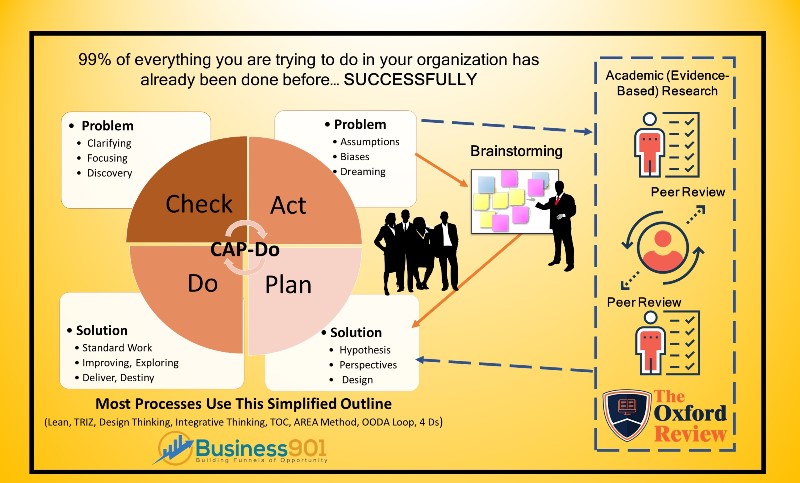
Lean needs to adapt its thinking and seek new ways to engage the users in their learning cycles. The methods of SDCA-PDCA-EDCA are well suited for this new environment. The practice of Hoshin Kanri lends itself for adaption of this new thinking throughout the organization. However, it will take a change in thinking of many established Lean Enterprises and Organizations if Lean is to continue to flourish.
Other process methodologies of the 90s are floundering; Lean is flourishing because it has been the most adaptable. It has spread to many disciplines through an internal focus on improvement. However, it may be ripe for disruption as the external forces of the marketplace take hold. Will the Lean Startup be an instrument of disruption or a savior for its Lean counterpart?
P.S. This blog post is an extension of my recent posts, Is Lean Playing to Win? Part 1 of 2 and Is Lean Playing to Win? Part 2 of 2. The posts are my reactions to this LinkedIn thread, What do we have to do to have Lean survive a leadership change?,
Growth is about People, not Process or Product
Posted by: | CommentsIf you can build a culture of PDCA, a culture of learning, growth becomes part of everyone’s job. It is this aspect I believe that separates good companies from great companies.
There is not an internal factor that will be more limiting or more expansive than the people within the organization. Building a learning culture with a properly formed structure is the single most important role that leadership has but often the most difficult. In mature companies, you will hear about transforming to a Lean Culture and the difficulty of change. In startups, we discuss the transitional process that the founder must go through as the company matures. Both areas are significantly different, but the three components are relatively the same; Structure, Culture and Learning.
I was president of a company that tripled personnel one year from twelve to thirty-six people. All things went pretty well. The core group of twelve was an amazing group and several of them adapted to leadership roles well, we prospered. The next jump from thirty-six to sixty people did not quite go as well. Our organization structure contained to many generalist and we required a few specialist to be hired that just by the nature of the new structure were competing for authority with the generalist. Several of the generalist were no longer in the same positions of authority and, as a result, struggled with their new positions. We also experienced a few more personnel issues as a result of people not being trained and ready for leadership. It was a time that I developed a new sense of respect for line managers. I found out that the company strength and potential for future growth was limited to that last line of management.
What happens in mature companies is that they have an existing structure and frequently do an excellent job of developing people for leadership. Growth often times takes on a different form in this arena; it is a form of specialization within silos. Growth occurs because of this uniqueness and offering. However, the more specialized a silo is the more independent it becomes. This often does not fit with the existing culture and structure.
Structure is often considered a easy process of drawing an organizational chart and fitting existing people into those roles. We hire to fill the gaps or ask people to wear two hats. After all, we are all flexible. This may work on paper, but in reality it fails miserably. In Lean circles, you will hear Culture blamed for just about every Lean failure. You also hear the quote “Culture eats Strategy for Lunch”. I would like to add my own, “Structure eats Culture for Breakfast”.
Our processes are built as a result of the internal structures of our organization. It is how we get things done. If we do not change the structure, (Review: A New Approach to Lean – Robert Fritz) we will not be able to meet the demands our customers require. The proper structure is a combination of the typical organizational chart and a Venn diagram. The best model that I have found to do this is the Lean model of Leader Standard Work explained in David Mann’s book, Creating a Lean Culture: Tools to Sustain Lean Conversions, Second Edition, Second Edition. For more information on Lean Standard Work review the Learning Lean Training Module on LSW.
The Lean practice of Hoshin Kanri allows us to consider what types of structural changes we need to make. This process not only allows for change, it actively seeks it. Change and restructuring become naturally motivated. As we progress, the organization becomes clear about the vision we share and joins together in making change work. For more information on Hoshin Kanri review the Learning Lean Training Module on Hoshin Kanri.
Another important aspect of growth is learning. I am not referring to additional schooling or conferences. My reference is learning from within and outside the organization. However, if you do not build an internal learning structure what you learn from vendors, customers and markets will go for nil.
What people forget about Lean is that it is the change agent for an organization. In its simplest form, you first go and see the current state. Second, you visualize your process. You make your process steps visible. You visualize things in a way that reveals your problems, not in a way to hide problems. If you understand what standards are, how the process should work because it’s very clear, then whenever we see a variation from the process we react immediately. This allows you to choose one problem from the other and just solves them one by one. This is incredibly powerful, this vision we have with Lean systems of increasing our competency, increasing our training without having to take people off line, without having to get to classrooms, but by building it into the way we work. It is this empowering aspect that is not easy. However, it may be the only way an organization can master Lean. – From the training module below.
If you can build a culture of PDCA, a culture of learning, growth becomes part of everyone’s job. It is this aspect I believe that separates good companies from great companies. For more information on PDCA review the Learning Lean Training Module on PDCA.
This week, April 22nd thru the 26th, we will concentrate on how to grow, or scale-up your small business. I will be scaling-up the entire week culminating in a webinar, The Lean Scale Up, which is followed by a period of Q & A on the afternoon of April 26th. Only registered participants will be invited to webinar and Q & A.
Interesting Mapping Exercise
Posted by: | CommentsTellus Mater created this video that I found via a tweet by Robert Lusch (@RobertLusch) co-editor of The Service-Dominant Logic of Marketing. I believe that the message Tellus Mater sends is interesting. I can honestly say that I am not qualified to express an opinion on how valid it is. However, I find it similar to how I would try to explain most successful demand chains. It is a fantastic mapping exercise for this purpose.
What do you think?
Tellus Mater’s mission is to catalyze a shift to sustainable capitalism: to change the operating rules for capitalism so that finance can better fulfill it’s role in directing the flows of Financial Capital to production systems that preserve and enhance Natural Capital.