
In the world of manufacturing and modern market design, the “commodity trap” is a constant gravity well. Every day, global competition, rapid prototyping, and digital transparency pull well-established firms toward lower margins and interchangeable product status. To escape this gravity, a manufacturer cannot simply be “better” at making what they already make. They must become Market Shapers.
Market shaping is the active process of influencing the structure and dynamics of an industry to create a new category of value. It requires more than just a good engineering team; it requires a specific orchestration of intelligence.
Enter The Triune Edge.
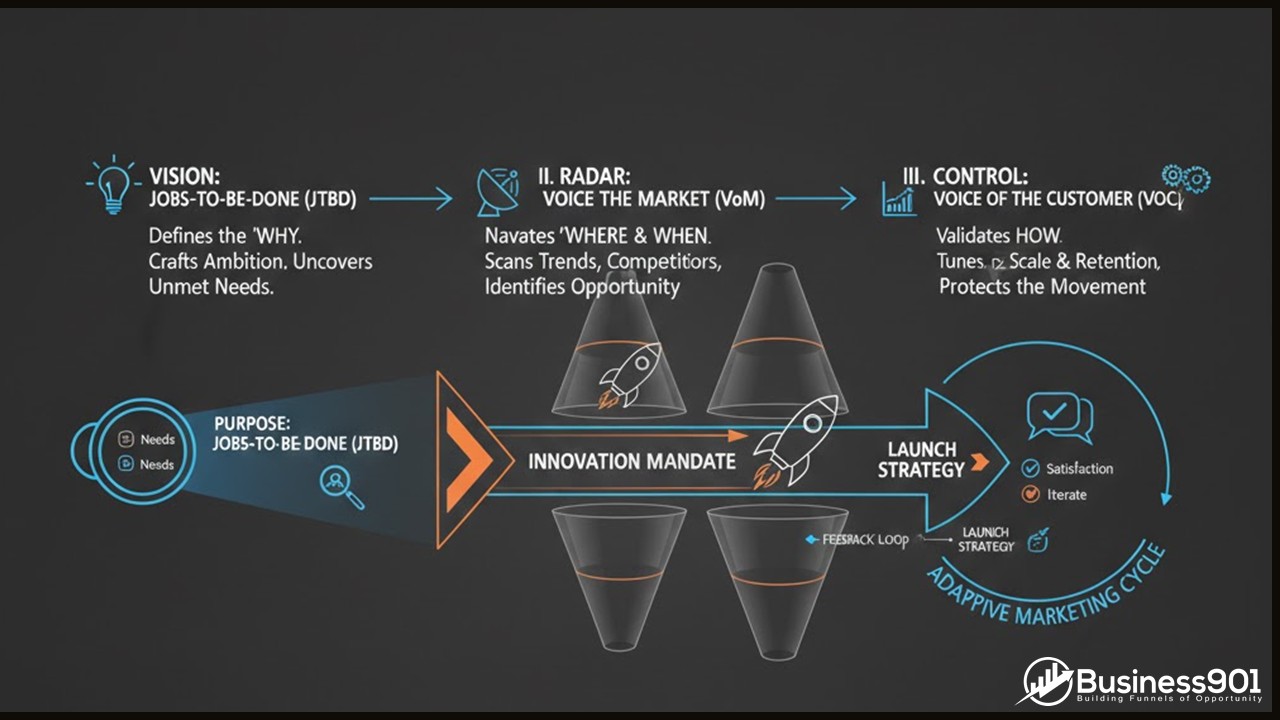
The Triune Edge is a practical three-part framework for modern market design. It names three complementary intelligences that every leadership team must orchestrate: Jobs-to-be-Done (JTBD) as your vision-craft, Voice of the Market (VoM) as your radar, and Voice of the Customer (VoC) as your control loop.
Think of JTBD as the compass that sets your direction, VoM as the weather system that warns of storms and identifies tailwinds, and VoC as the engine diagnostics that keep the machine running at peak performance. Each alone is useful. Together, they create a living roadmap from a simple hypothesis to the creation of an entirely new market category.
I. Defining the Three Intelligences
To use the Triune Edge, we must first define the distinct roles these intelligences play in the “Funnel of Opportunity.”
1. Jobs-to-be-Done (JTBD): The Vision-Craft
JTBD frames the progress a customer is trying to achieve, the specific circumstances that create that need, and the trade-offs they are currently forced to accept.
- The Role: Use JTBD to craft ambition statements and non-negotiable success criteria. It defines the “minimal product” that can catalyze a shift in demand.
- The Power: It prevents the “Maturity Trap.” If you focus on the product (e.g., “We make hydraulic pumps”), you are stuck in an old category. If you focus on the Job (“Ensure zero-downtime fluid transfer”), you are free to invent the future.
2. Voice of the Market (VoM): The Strategic Radar
VoM is the aggregated signal of intent you can observe outside your direct customer conversations.
- The Role: It monitors search trends, competitive displacement, channel behavior, and macro-economic shifts.
- The Power: VoM tells you the “weather” of the industry. Is the market forming (new demand), fragmenting (customers splitting into niches), or freezing up (incumbents locking down the status quo)?
3. Voice of the Customer (VoC): The Control Loop
VoC is the granular feedback loop from the people actually using your product.
- The Role: Support tickets, retention cohorts, qualitative interviews, and NPS.
- The Power: VoC tunes the product for scale and retention. It is the “Engine Diagnostic” that protects your movement from backsliding into poor quality or high friction.
II. How the Intelligences Interlock
The Triune Edge is a single operating system, not a collection of independent tools. JTBD sets the ambition, VoM scans the environment for signals that confirm that ambition, and VoC closes the loop by revealing if the Job is actually being executed.
Navigating the Tensions
Orchestrating these three requires managing three natural tensions:
- Pace: JTBD demands conviction; VoM urges caution; VoC requires rapid iteration.
- The Rule: Lead with JTBD early, watch VoM as you scale experiments, and let VoC dominate once retention matters.
- Aggregation: VoM works at scale; VoC is idiosyncratic; JTBD is the bridge.
- The Rule: When VoC patterns repeat, treat them as VoM signals. When VoM shows a divergence, test a new JTBD hypothesis.
- Ownership: Product teams own JTBD; Strategy owns VoM; CS owns VoC.
- The Rule: Fix silos with rituals. Assign a single owner per intelligence but require cross-functional decisions to pass the tests of clarity, evidence, and alignment.
III. Practical Decision Rules for Market Leaders
Practical leaders use simple decision rules to move between these intelligences without losing momentum.
The 3-2-1 Accountability Test
Within three weeks of launching a JTBD-driven experiment, you must collect two independent VoM indicators and one VoC signal. This data must either validate continuation or trigger an immediate pivot. This preserves momentum while enforcing early evidence.
The Escalation Ladder
If VoM and VoC disagree for more than two cycles (e.g., the market trend says “Go” but users say “No”), escalate to a strategy review before increasing spend. This prevents “slow-motion” balance-of-power fights between departments.
IV. The Diagnostic Checklist: Pre-Flight for Every Initiative
Before you fund a new experiment or pause an existing one, run this diagnostic:
- JTBD Fit: Can you state the job in one sentence and list the functional, social, and emotional outcomes?
- VoM Signals: What three market-level indicators (e.g., search trends, category pricing movement) will show traction?
- VoC Triggers: Which two user-level measurements (e.g., task completion rate, 30-day churn) will confirm quality?
- Resource Alignment: Do you have the budget for a three-week cycle and at least one follow-up iteration?
- Escalation Path: Who owns the final go/no-go decision?
V. Starter Rituals for Immediate Implementation
You can implement the Triune Edge in a single week with these low-overhead, high-signal rituals:
- Weekly Radar Sync (20 Minutes): The VoM owner presents two market changes and one competitive move. The Product Owner records any resulting hypothesis updates. This translates noise into testable bets.
- Monthly Triage (60 Minutes): The VoC lead brings two anomalies and one recurring complaint. The team decides to iterate, hold, or escalate. This creates a predictable cadence for customer pain to change GTM priorities.
- Early-Access Circle (Biweekly): A small group of early adopters validates messaging and friction points. This keeps JTBD grounded in real-world usage.
VI. The Scaling Decision Tree
When you reach a crossroads, use this logic to decide your next move:
- Node A (Market & Customer Confirm): Scale incrementally and monitor VoM lead indicators.
- Node B (Market Confirms, VoC Shows Friction): Pause scaling. Prioritize an experience sprint and re-run the 3-2-1 test.
- Node C (Market Fails, VoC niche loves it): Consider a focused pivot to that specific niche.
- Node D (Neither Respond): Kill the experiment and capture the learnings.
Conclusion: Lead or Listen?
Markets do not change because you build a feature; they change when people adopt a new way to get a job done. The Triune Edge is your operating manual for deciding when to lead with conviction and when to listen to evidence. By applying these diagnostics and rituals, you reduce waste, accelerate learning, and increase the odds that your next product not only ships but also shapes the market.