
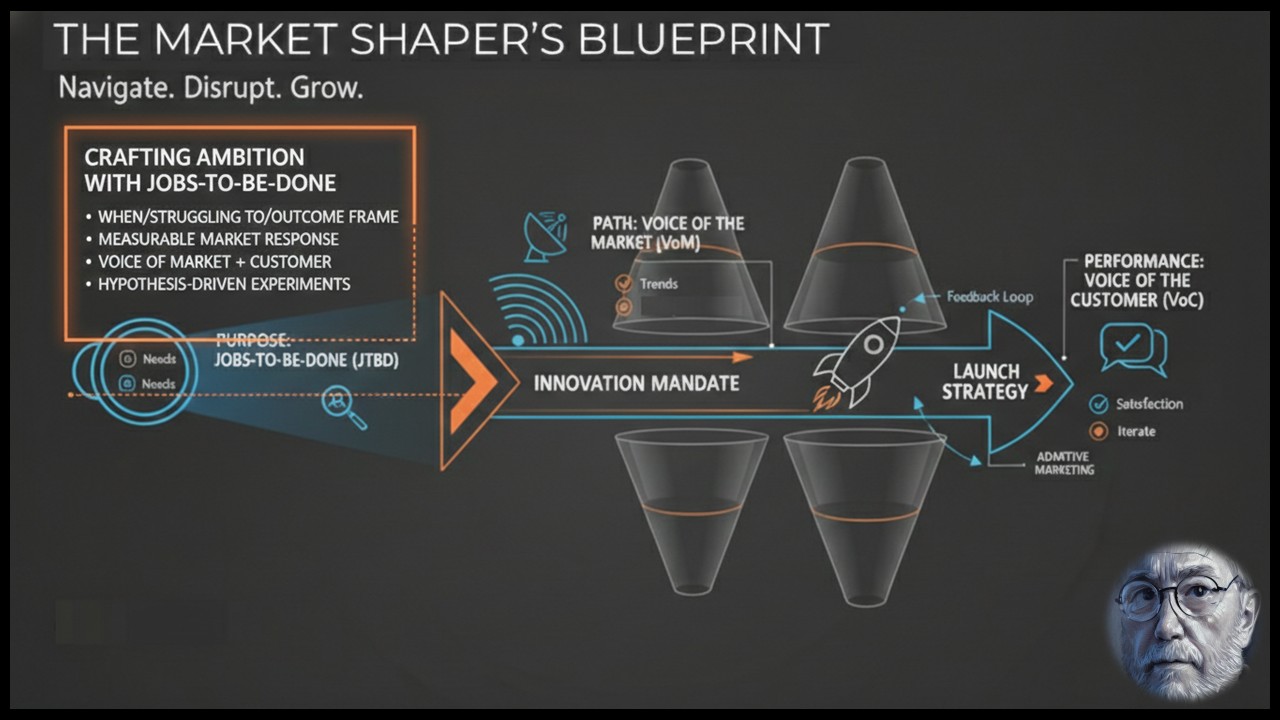
When leaders draft mission statements, they aren’t just writing copy; they are attempting to project a future state. They envision a world where their customers are transformed, markets are disrupted, and growth becomes an inevitable byproduct of their presence. However, a systemic gap exists between the boardroom’s ambition and the engineer’s sprint.
The problem is that most missions remain aspirational, vague, or—most dangerously—inward-looking. A mission that proclaims, “We empower professionals to work smarter,” may sound noble during an annual retreat, but it fails to provide a compass for daily operations. It doesn’t tell a product manager when to act, a marketer what to measure, or a designer how to validate a feature.
To bridge this gap, we must move beyond “vision” and toward the Ambition Blueprint. This requires converting broad statements into precise, testable Jobs-to-be-Done (JTBD) outcomes. By doing so, you turn a fuzzy bet into a disciplined experiment where waste is minimized, and conviction is quantified.
1. The Anatomy of Precision: The JTBD Frame
The primary reason missions fail to drive results is a lack of context. “Empowerment” and “Efficiency” are abstract concepts. To make them concrete, we use a simple, forcing frame:
When [Context] struggles with [Pain Point], the customer wants [Desired Outcome] so that [Functional/Emotional Goal].
This structure forces a sentence that captures the three pillars of market reality: context, struggle, and success.
Fictional Case Study: From Productivity to Precision
Consider a mid-stage SaaS company whose mission was to “Improve field productivity.” Despite high ad spend and ongoing onboarding tweaks, their growth stalled. They were building “productivity features” that no one was hiring.
They reframed their mission using the JTBD lens:
- Original: Improve field productivity.
- JTBD Reframing: “When a service technician arrives at a remote customer site, struggling to identify the correct equipment history and specific replacement parts, they want to complete diagnostics and order parts within 15 minutes to avoid a costly follow-up visit.”
The difference was transformative. The team stopped building generic “productivity” dashboards and redesigned a single, high-stakes workflow. By measuring time-to-repair rather than “app logins,” they reduced repeat visits by 28% in two quarters. The mission became a measurable target, and the market responded because the solution finally matched the struggle.
2. Avoiding the Vision Traps
As you convert your ambition into JTBD outcomes, you must navigate three common traps that often derail leadership teams:
- The “Feature-in-Disguise” Trap: Defining the Job by your solution (e.g., “The customer wants a dashboard”). The Job exists independently of your product.
- The “Persona Over Context” Trap: Focusing too much on who the customer is (demographics) rather than the situation they are in. A CEO and a college student might “hire” a quick coffee for the same “When” (When I have 5 minutes between high-stakes meetings/classes).
- The “Passive Outcome” Trap: Using verbs like “understand” or “know.” Instead, use “minimize,” “reduce,” “achieve,” or “order.”
3. Designing the Hypothesis: Measuring “Willingness to Hire.”
Once you have your JTBD outcome, you must treat it as a hypothesis, not a fact. The goal is to run experiments that prove demand and convert awareness into hiring decisions.
A crisp JTBD hypothesis looks like this:
“We believe that [Target Segment] in [Context], struggling to [Problem], will be willing to trade [Time/Money] to achieve [Outcome].”
The critical shift here is measuring the willingness to hire, not just vanity metrics. A click on an ad or a newsletter signup is a low-fidelity signal. A “hiring decision” is an exchange of value.
The Ladder of Commitment
Don’t jump straight to a full product launch. Run a sequence of escalating tests that increase the “cost” of commitment for the user:
- Level 1: Message Resonance. Use targeted landing pages to see if the JTBD language actually stops the scroll.
- Level 2: Friction Point. Offer a “lightweight” commitment, such as a scheduling call or a refundable deposit.
- Level 3: The Exchange. Test a paid pilot or a limited-scope purchase.
Each step should raise the stakes. If a customer isn’t willing to spend 15 minutes on a diagnostic call to solve their “struggle,” the struggle isn’t painful enough to build a business around.
4. The Sensors and Control Loops: VoM and VoC
The JTBD outcome is your “North Star,” but you need “Sensors” to tell if you’re actually moving toward it. In the Triune Edge framework, we use Voice of Market (VoM) and Voice of Customer (VoC) as indicators.
| Indicator | Focus | Example Metric |
| VoM (Market) | Is the problem widespread? | Search volume for the “struggle”; Competitive displacement rates. |
| VoC (Customer) | Does our solution solve the specific “When”? | Conversion from “struggle” to “outcome”; Task completion time. |
Competitive Displacement: The Ultimate Truth
A powerful but underutilized tactic is the Competitive Displacement Test. Instead of asking customers if they would switch, create an offer that explicitly targets their incumbent behavior. For example: “Switch your monthly service to us and get the first month free.” Observing whether a customer actually changes a vendor, a budget line, or a long-standing manual workflow reveals the true strength of your JTBD fit. It also surfaces hidden switching costs—the “anxiety” of the new—that your product team must address.
5. Discipline Over Hope: The 3-2-1 Accountability Test
Ambition without accountability is just a daydream. To ensure your JTBD outcomes lead to growth, every experiment should be mapped to the 3-2-1 Accountability Test:
- 3 Clear Hypotheses.
- 2 Leading Indicators (e.g., preorders or scheduling requests).
- 1 Binary Decision Rule (e.g., “If 10% of leads don’t book a call, we stop”).
Instrument your experiments. Track conversion rates between stages rather than absolute counts. This allows you to see where the friction is. Use cohort slicing by context variables—such as user role or the specific “trigger” event—to find high-propensity segments where the JTBD is most acute.
6. From Vision to Governance: The Review Ritual
The final component of crafting ambition is the feedback loop. High-growth teams utilize a standard Experiment Review Ritual. This isn’t a long, winding meeting; it is a 15-minute cross-functional session focused on three specific outputs:
- The Signal: What converted? What did they actually “hire” us to do?
- The Friction: Where did they drop off? Was it the price, the complexity, or a lack of trust?
- The Decision: Based on our pre-defined thresholds, do we Scale, Iterate, or Stop?
Treating conversion thresholds as governance is the ultimate “runway extender.” It prevents teams from pouring resources into “zombie projects” that have a vision but no market hire.”
Conclusion: Sharpening the Edge
Clarity is what separates hopeful plans from category-creating moves. Your ambition is the engine, but the JTBD outcome is the steering wheel. By converting vague missions into precise, testable outcomes, you empower your team to act with conviction.
The goal is not to eliminate your vision; it is to focus it so sharply that it becomes a measurable reality. Keep your high-reaching ambition but sharpen your language. Use the
“When/Struggling to” frame to define the target, then use VoM and VoC sensors to prove it. When you stop guessing and start measuring the “willingness to hire,” you don’t just build products, you build solutions the market has been waiting for.