Forming Expectations Through Promises

“If you can trust a promise, you can save a lot of time and effort. It helps you to form expectations, and that expectation is knowledge that you build up by having a relationship with something or some process or some personal device.” – Mark Burgess Related Podcasts and Transcription: The Theory of a Promise Read More …
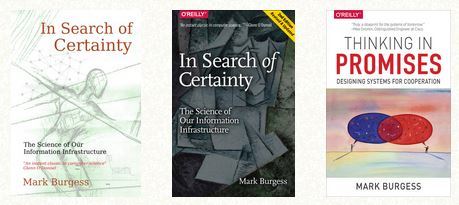

Designing through Promises, Part 2

Mark Burgess is perhaps best known as the author of the popular configuration management software package CFEngine, but has also made important contributions to the theory of the field of automation and policy based management, including the idea of operator convergence and promise theory. Mark is the author of numerous books, articles, and papers on Read More …

An A3 Retrospective

Lean Thinking is often developed through a structured approach using a tool such as an A3. It is one of the best ways, I believe in developing a problem-solving culture through practice. The easiest way to start is to purchase Jamie Flinchbaugh’s Kindle book, A3 Problem Solving: Applying Lean Thinking . It does an excellent Read More …

Designing through Promises

Mark Burgess is perhaps best known as the author of the popular configuration management software package CFEngine, but has also made important contributions to the theory of the field of automation and policy based management, including the idea of operator convergence and promise theory. Mark is the author of numerous books, articles, and papers on Read More …

From Thinking About Things

From Thinking About Things to Thinking About Relationships. The readers of my blog will recognize many of the terms Jeff Sussna used throughout the book, Service Design, Service Dominant Logic, Jobs to be Done, and Design Thinking, I asked if he had an underlying thread to all of it? Related Podcast and Transcription: Digital Services Read More …

Starting w/ Numbers, Start w/ Variability

You spend a lot of time, talking about variability. Or maybe not a lot of time, but you start out with that because that really is whether numbers work or not.- jd Related Podcast and Transcription: Interpreting Data Kaiser Fung:  Yes. I think somewhere in the book I have said that you could, in fact, Read More …