Agile Marketing Development

Lean Marketing House™

Value Stream Marketing

Archive for Marketing Funnel

Kanban is any signaling device that gives authorization for a supplying process to know what to produce, or for a material handler to know what items to replenish. For example: a physical paper card placed in a container of parts. When stored items are actually used, the Kanban card gets “freed” (perhaps it was in the bottom of the container), and gets put back into a Kanban stand where the Kanban “requests” are fulfilled. Kanban

Kanban is a way of limiting work in process and the amount of new work that is introduced into the process. As a result, work would be pulled from the previous stage as work is completed and levels demand. It emphasizes throughput rather than numbers. If you have read my previous posts, you would recognize the emphasis I put on throughput and the need for this to be monitored in the sales and marketing process.

The Reasons for a Kanban can be summed up in these previous posts:

Improve your Marketing Cycle, Increase your Revenue : Speed is important in the buying process. Your total cycle time can be improved. However, it seldom can be done without more feedback loops in your system.  Develop process blitzes to reduce these non-value times. Go to Gemba or the customer’s place of work and find out what happens during this time. See what is stopping them from moving forward. It may be an internal constraint within their company. However, the constraint may be yours. You may not be responding to the customer’s latest needs. Your ability to focus your resources on the customer needs may provide the overall clarity he needs this to make a more rapid decision.

Improve throughput, cut your customers in half!: In a manufacturing system cutting WIP just about always will increase throughput. Why? You end up working only on what is needed and when it is needed. You also will have less waste, less material to handle and fewer mistakes. Good things happen when you are not handling excessive amount of material. In a marketing system cutting the amount of customers in half works very much the same way. You end up working on what a customer truly needs and wants. Your marketing will become more personal, more direct, and fewer mistakes.

Using the Six Sigma Tollgate in your Marketing Funnel: Have you thought of using DMAIC as a way of defining your marketing funnel? We looked at Define, Measure, Analyze, Improve and Control and utilized these basic principles to walk a customer through the marketing funnel. In other posts, I discussed the ability to create a shorter cycle time by decreasing the non-value time in between each of these stages. One of the methods of doing this is to have a strong call to action for a prospect to move from one stage to the next. However, how do you know if a customer is ready to move from one stage to the next?

What kind of questions would you ask at a tollgate?: In a recent post, using the Six Sigma Tollgate in your Marketing Funnel I went through the concept of using a tollgate in your marketing funnel. Below is a list of questions that might help general a few ideas that you may want to consider. (Review Post)

The essential points needed in a Kanban system are:

  1. Stock points
  2. Replenishment Signal
  3. Quick Feedback
  4. Frequent Replenishment

DMAIC Marketing

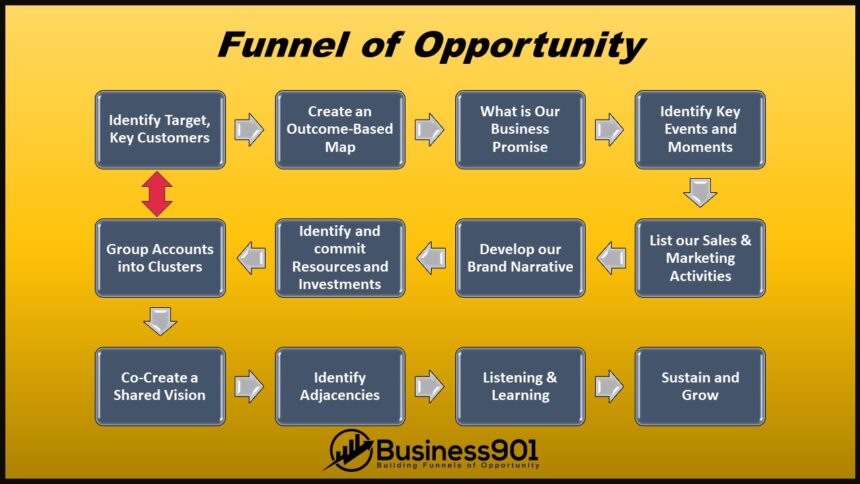
If you would consider the typical marketing cycle as a prospect moves from one stage to another, you imagine it as step by step process and certain events taking place within that stage. With a Kanban method or a tollgate you could have certain trigger points for each stage or even a phase within that stage allowing one marketing effort to pull from the previous. The method would also limit the number of prospects within that cycle so that the proper amount could be managed or more importantly satisfied! Or, you could have an unlimited supply of leads flowing into each stage? You probably wish you had the latter. However, which would prove more effective?

Photo Courtesy of Systems2win.

Everyone tells you to differentiate but are you comfortable that you are different enough. A tool that I use to make a strong impact on a client is one that is from the book, The Chasm Companion: A Field Guide to Crossing the Chasm and Inside the Tornado (Revised).  Here is how you complete it:

image

The benefit your service/product is to the user:
    A. Provide Modest Enhancements
    B. Add substantial value
    C. Gives dramatic productivity gains.
    D. Changes the competitive field

The pain of obtaining the benefit to the user:
    4. Significant reengineering, new systems 
    3. Major changes to existing systems 
    2. Modest changes to existing systems 
    1. Integrates with existing systems

When completing this of course the more opinion and arguments the better. You will have to create a consensus, however and a decision reached. Sometimes positioning the competitor’s products/service around yours can assist. Are more changes required, do they add less or more value? If you end up at square A4, no Gain with a lot of pain, you can probably throw the product/service away. It simply will not work. In fact A2 and A3 should probably cause the same reaction. The truth to the matter is that unless you are doing a startup, you probably end up in the twilight zone. The problem being in the twilight zone, according to author Geoffrey Moore is that these offerings will cause little market movement. In other words, they are not COMPELLING. The other areas follow this pattern:   

  • D4, you are in an early market category.
  • D2/D3 is about market segmentation and making the pain a favorable trade-off to that group.
  • C1/D1 means that your product can move to widespread adoption and you are ready for that transition.
  • A1, B1 is being accepted in your target market and an easy solution. 

This description is a take-off from the book but to fully understand you have to read the Crossing the Chasmclip_image001. It is a must read and still today it is one of most cited books in the innovation area. I have bought the book around 5 times. I keep giving it away.

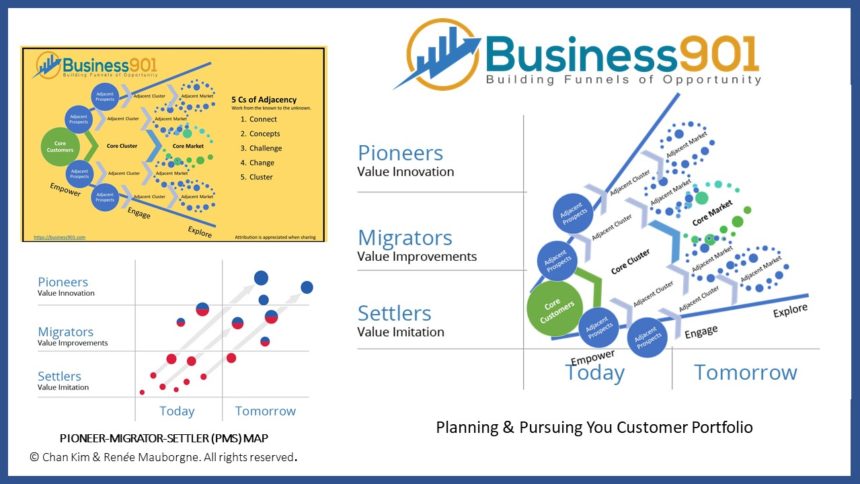
However, the point to this entire exercise for me is differentiation relative to the gain and pain of the customer. It is an exercise that enables you to look at your product/service more objectively from your customer’s eyes. Are you really that different if all you are doing is complicating their life without making a significant gain? Another item it addresses is your market segmentation. Are you targeting a customer that your product/service causes little pain? If you are in the twilight zone, where are you headed? What will it take to move you to the outer perimeter? It is a simple answer make yourself more valuable by making the gain greater or the pain less!

Related Posts:

Evaluating your Marketing Funnel, Only Seven Levers matter

Lean Marketing, The Toyota Way

The Marketing Funnel using Six Sigma DMAIC – Define stage

This past year I have given the following workshops:

  • Getting Started in Social Media
  • Marketing your Black Belt
  • Get Clients NOW!
  • 7 Steps to Small Business Success aka Duct Tape Marketing
  • Become Employable
  • Becoming Self-Employed
  • Lean your Marketing with Referrals
  • The Pillars of the Lean Marketing House
  • Get Hired NOW
  • Lean Marketing Assessment
  • Funding your Nonprofit
  • Etc.

The reason I list them is there is a common theme in all of them and in Seth Godin’s Blog today he mentioned it in a slightly different way:

Seth’s Blog: First, organize 1,000

In Summary: What’s difficult? What’s difficult is changing your attitude. Instead of speed dating your way to interruption, instead of yelling at strangers all day trying to make a living, coordinating a tribe of 1,000 requires patience, consistency and a focus on long-term relationships and life time value. You don’t find customers for your products. You find products for your customers.

He also mentioned Kevin Kelly’s blog The Technium discussion on 1,000 True Fans.

In Summary:  The key challenge is that you have to maintain direct contact with your 1,000 True Fans. They are giving you their support directly. Maybe they come to your house concerts, or they are buying your DVDs from your website, or they order your prints from Pictopia. As much as possible you retain the full amount of their support. You also benefit from the direct feedback and love.

So what was my common theme: Most people know approximately 300 people on a casual basis. In fact, when not knowing, many wedding planners, funeral directors will use than number as a figure.  So if you know 300, does that mean your wife or husband will know 300 probably not but maybe a 100. What about both of your parents, your siblings, your cousins and people that know you well? Everyone knows 300 people. If you start working with just the people you know in a short time period you can effectively  be marketing to a 1,000 people. If you are a professional service provider, looking for a job or even a nonprofit. Getting to that 1,000 people plateau can be very effective.

job search

1,000 is not that big of number! And it is a great goal for the New Year,  Go for it!.

Related Post:
Where do you start your job search?
Using the Theory of Constraints in Marketing
Another word for Marketing – How about Voice of the Customer?

Business901 Blog

Subscribe to Business901

Get the latest updates delivered via email

Lean your Marketing

Enter Your Name:
Enter your Email: